Project Outcomes
The Challenge
The foundation of ASME ISHOW’s hardware benchmarking framework was established under IDEA LAB through creation of a matrix covering the first three Product Development Milestone (PDM) across key various areas of progress. ASME now sought to build out of the rest of the matrix, extending it through the full hardware innovation development journey from prototype (PDM 4) through to product launch (PDM 9). Second, the process of placing and tracking ventures was capacity-intensive for the ISHOW team, relying heavily on manual expert review and synchronous engagement making monitoring at scale unsustainable.
Objective
This project aimed to build out and streamline ASME ISHOW’s processes and frameworks for evaluating the status and progress of its supported innovations. We built on work previously started by the ISHOW team to develop a matrix for evaluating innovations’ progress against the 9 Product Development milestones and ISHOW’s 5 pillars necessary for the success of hardware innivations (Customer & User Knowledge; Hardware Validation; Development & Manufacturing; Implementation Strategy; Impact). The focus was on streamlining the process, using automation where possible, to reduce capacity demands on ISHOW and the innovators. We also aimed to develop general guidance for ventures for progressing to the next milestones.
Outcome
The framework extended ISHOW’s existing baseline through PDMs 4 to 9, covering all 9 sub-pillars across the full hardware development journey from Low-Fidelity Prototype to Product Launch. Each sub-pillar at each PDM stage was defined through three levelled milestone statements following an entry, depth, and bridge arc giving ventures a clear progression path and giving ISHOW a consistent, replicable standard for assessing progress across a diverse global cohort. The system assessment of the section framework addresses the self-reporting accuracy gap by placing ventures based on confirmed operational evidence. Together these two components; the framework and the System assessment section formed the foundation of a benchmarking tool that operates at scale to offer guidance to hardware ventures.
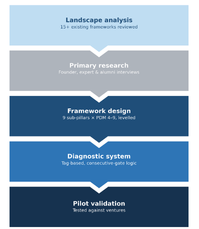
The Core Project Workflow
Attribution: Ebby Lari