Critical mineral supplies are under strain as industries race to secure them for everything from electric vehicle batteries to renewable energy infrastructure. This webinar brings together leaders from mining technology, sustainable finance, and policy to explore how industry can build resilient critical mineral supplies, scaling supply chains while reducing risk and cost.
Discussion centers on the multiple complementary paths industry can take toward de-risking the critical mineral supply. On one front, recycling and urban mining are increasing the resilience of the supply. This work includes end-of-life battery recovery, electronic waste collection and processing, and secondary byproduct recovery from industrial operations.
On another front, companies like Mariana Minerals are addressing challenges at the source, applying autonomous mining and refining technology to cut the cost and complexity of extracting critical minerals domestically. And finally institutions such as ING are helping to scale the companies that source critical minerals through financing and investment strategies and strategic partnerships.
Together, these approaches represent diversification that creates a more secure and resilient supply chain. For details please see the video highlights below.
For a deeper exploration of the issues, read panel’s answers to questions during the live event: Your Questions About Future-Proofing Critical Minerals Answered
This presentation is part of the CATALYZE Series, connecting to themes of the CATALYZE Summit. The Summit is a two-day, in-person gathering taking place in April 2027 in Detroit, Michigan, where engineers, researchers, and practitioners will convene to accelerate climate solutions across industry. CATALYZE is co-produced by the American Society of Mechanical Engineers and Constructive, a nonprofit reshaping cross-sector collaboration to advance clean energy and climate solutions.
Policy, Risk, and New Supply Chains for Critical Minerals
The United States and its allies can reduce strategic risk from highly concentrated critical mineral supply chains, Abigail Hunter, Executive Director of SAFE’s Center for Critical Minerals Strategy, explains. She outlines why these minerals matter for manufacturing, jobs, innovation, and defense, and how China’s dominance in processing creates geopolitical and economic vulnerabilities.
Abigail walks through new US Geological Survey criticality methods, key high risk minerals, and a broad “all-tools” US policy response. She also highlights the role of private capital, international partnerships, and real-world public–private deals that are building more resilient supply chains not dependent on China.
Critical Minerals Innovation in US National Labs
Which innovation practices are working, and what should come next for critical minerals in the United States? Speaking as an advisor to Argonne National Laboratory, Abigail Hunter argues that national labs are essential incubators for new technologies in exploration, processing, and materials.
She explains how programs at DOE’s national labs, ARPA‑E, and DARPA help de-risk early-stage technologies, validate performance, and give end users confidence in new processes and materials. Because many critical mineral projects are “first-of-a-kind” and already carry high technical and market risk, she stresses that these innovation engines must be first in line for government support and then efficiently scaled beyond the lab, so promising ideas can move from TRL stages to real commercial deployment.
Can AI-Driven Mines and Refineries Beat the US Critical Minerals Supply Shortage?
Autonomy and software can transform mining so the United States can scale its critical mineral supply, Darian Orozco, Sr. Director of Process and Plant Engineering at Mariana Minerals, explains.
Facing a looming supply crunch with depleted deposits, lower ore grades, and deeper, costlier mines, Darian argues for an “autonomy-first, software-first” approach across the entire project lifecycle. He introduces us to three integrated platforms: Capital Project OS to compress and de-risk mega‑project delivery, MineOS for real‑time autonomous mine planning, and PlantOS to use AI and reinforcement learning to continually optimize refinery performance.
Automation, he argues, is now essential given costs, schedules, and workforce constraints in the States.
Every Ore Body Is a New Puzzle for Engineers
Darian Orozco describes engineering challenges that make modern mining both difficult and exciting. Unlike petrochemicals where plant designs barely change for decades, every ore body is unique. Mineralogy and chemistry differ from site to site, so each project needs a bespoke flow sheet, which makes economies of scale hard to capture. Mariana Minerals’ answer is to break refineries into modular unit operations that can be modeled, reused, and combined—supported by strong datasets and simulation tools.
Darian also describes a “holy grail” challenge: closing the loop from mine to refinery. The goal is to measure ore composition in near real time, feed that data forward, and dynamically adjust refinery settings before the material arrives. Achieving this would maximize yield and cut costs—but, as he notes, it remains a major technical hurdle they’re actively working to solve.
Making Critical Mineral Tech Bankable: ING’s Sustainable Solutions Strategy
Sustainability-focused project finance can turn first-of-a-kind critical mineral technologies into bankable projects. Cindy Jia, Managing Director and Head of the Sustainable Solutions Group Americas at ING, shows how.
Cindy explains ING’s role as a global lender with deep metals and mining relationships, and why her team focuses on early, less-proven but promising technologies rather than only mature assets. Cindy walks through how lenders assess bankability and commercial viability for innovations such as lithium recovery from low‑grade brines, permanent magnet recycling, and processing black mass. She then breaks down how project finance and creative deal structuring can bridge the “missing middle” between R&D pilots and large commercial plants, lend primarily against project cash flows, and lower overall capital costs versus venture debt or private credit.
Drawing on ING’s technical expertise and global network, Cindy offers a practical roadmap for entrepreneurs, engineers, and investors working to scale sustainable critical mineral projects.
How to Finance First-of-a-Kind Critical Mineral Projects
Cindy Jia explains how critical mineral technologies move from lab experiments to bankable commercial assets, and why many stall in between.
Early R&D (TRLs 1–3/4) is usually backed by government grants. Pilots and demos (mid TRLs) are funded by venture capital to prove the technology works outside the lab. The real bottleneck is the “missing middle”: financing the first commercial-scale project, where technical and execution risks are still high and big mining companies may hesitate, while more VC money is costly and dilutive.
Here, ING steps in with project finance debt that lends primarily against project cash flows, focuses on economics and performance at scale, and uses structure and due diligence to manage risk. Compared with venture debt and private credit, this can lower capital costs and help push projects from pilots to full commercial deployment.
Presenters

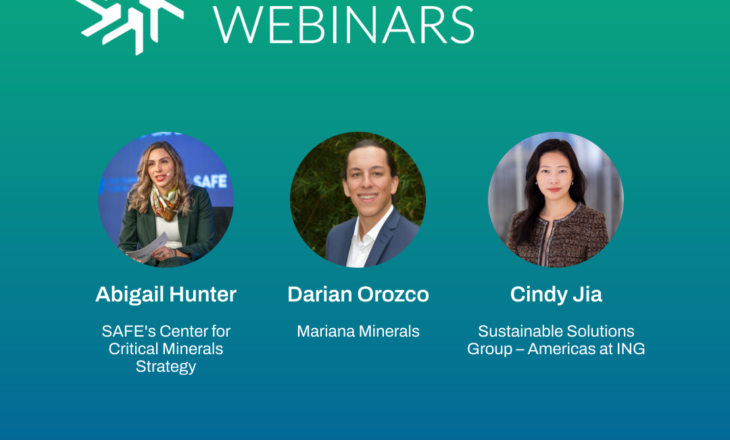
Abigail Hunter, Executive Director of SAFE’s Center for Critical Minerals Strategy, brings deep policy and market expertise on building resilient, secure critical mineral supply chains for the industries and technologies of the future.

Darian Orozco, Sr. Director of Process and Plant Engineering at Mariana Minerals, shares insights from the company’s work developing autonomous mining and refining operations, including what it describes as the world’s first autonomous mine. By applying robotics and software to reduce mining costs by 50% and refining costs by 30%, Mariana Minerals is working to reinvent how mines, refineries, and infrastructure are built, while helping expand U.S. domestic production of critical minerals.

Cindy Jia, Managing Director and Head of the Sustainable Solutions Group – Americas at ING, offers a financial sector perspective on scaling these solutions. She shares insights on how to build the right capital stack for each stage of a company’s growth trajectory, key bankability requirements for early commercialization projects, as well as how to develop value-chain partnerships to take things to the next level.
Cindy heads ING’s Sustainable Solutions Group for the Americas region, providing tailored advisory and financing solutions to support clients’ sustainability projects and goals and to scale up new sustainable technologies and markets.
Cindy is a seasoned industry professional with a career spanning across project finance, technology development, and business strategy. Prior to joining the team, Cindy led a start-up developing advanced heat exchangers and reactors for industrial applications and helped the company and its partners win multiple awards from the US Department of Energy. Cindy was also first inventor of a novel heat exchanger that was selected for funding by the Advanced Research Projects Agency – Energy, one the DOE’s most selective programs sponsoring transformational research, alongside the likes of MIT, GE, and Boeing.
Moderator

Jake Wellman leads Constructive’s US programs including the Mountain West Geothermal Consortium and support for DERVOS and ASME CATALYZE. Bringing a combination of policy, strategy, and commercial experience, Jake has supported industry and government leaders to develop plans, investments and value capture opportunities related to the energy transition for over a decade.
More from the CATALYZE Series
How Regional Manufacturing Leads the Transition to Clean Industries